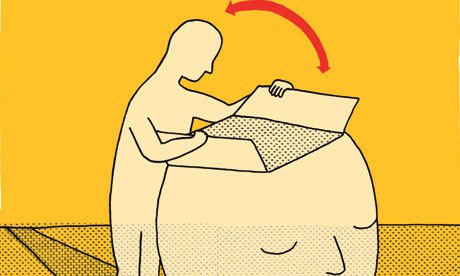
 For the last 4 months I had been seeing a therapist once a week to try to tackle my issues of negative thoughts, avoidance and fears. Yesterday was my last session after we both concluded that it was not making a significant impact on these aspects of my life.
That’s something like the 4th or 5th metal health worker I’ve seen in attempting to resolve some of my problems, so it’s really disappointing to have given it my all and had expectations for lasting change, yet nothing substantial came of the process. Especially as I was refereed to her by a big-name Psychiatrist I’d seen previously who had a lot of faith in her abilities.
The Format:
The first 3 or 4 sessions were pretty much for her to gather an understanding of my issues. I’ve got A LOT and it was clear that I’ve been dealing with long term depression and destructive habits for most of my life. Dealing with a case like myself is enough to test anyone I’m sure!
I did feel frustrated that after the 3rd and 4th sessions we were still discussing what’s wrong with me instead of taking positive actions to deal with it. Was this too much to ask? Before she met me, she had a chance to check out her referral notes about me and I helped by giving her a really well constructed and concise 2 page document about my life history, my problems and what it was I felt needed attention. To be honest, I hoped we’d be able to role with some solid, positive recovery strategies after the 1st or second session.
I did take the opportunity to say if I felt things were not going as I’d expected and if I was happy. She knew that she wasn’t the first person to attempt to tackle my issues so didn’t just want to go over the same ground, which was good. If I mentioned I wasn’t sure or was expecting more, she replied “it’s early days and it wont happen over night”. I know I can be quite impatient, so I let her have that one! I guess it makes some sense that if I’ve been living with a long term habit, I can’t just switch it off after a few hours of therapy (or can I?).
The next 10 or 11 sessions were pretty much a mix of listening to my issues and debating the validity of my negative thoughts. It turned out that she did end up going over a lot of the same stuff previous counsellors and therapists had :s This was particularly frustrating when covering certain strategies which I have no faith in or that do not resonate with me. For example:
“Let’s explore your childhood”
– let’s not! Not because I had a particularly bad one, but more that I don’t feel digging up the past is going to help me in the here and now. I felt that previous therapists had got me to do this so that I could dig up a painful memory, make me upset and they would feel they’re doing a good job to see me ‘release my emotions’.
In theory, that sounds reasonable. In reality, it makes the patient feel shit, then helpless as they can’t change their past, and then they leave the session with one extra negative thought in the front of their mind!
My latest therapist assured me this was important to gain understanding of myself and hoped that identifying when a habit may have formed, it would lessened the power my habits have over me. Or at least I think that was her main objective?
In theory, that sound reasonable. In reality, having the insight into my past, is interesting and that’s as far as it goes! Common sense tells us that we are a product of our experiences and I can’t see how this type of personal insight can even begin to change one’s long established habits or the way one interprets the world.
Maybe I missed the point? Maybe childhood regression techniques can help if one can then re-code a past memory or memories? If so, I wasn’t aware of any NLP style techniques we used to do this :s And even if I could re-code the first memory I had of a now destructive habit, I do not believe that would negate the 1000s of other times I had gone on to think in the same way as part of the habit, or offset the ‘evidence’ I’d acquired to support my negative beliefs and thoughts.
So to summarize the whole childhood thing, for me it’s a useless strategy. Perhaps unless it’s done properly and there’s more to it than just ‘let’s just look at your past’
“Thinking errors and counter statements”
– The idea is for one to recognise their irrational thoughts and to counteract with a positive, rational thought. This sounds great and is what CBT and most therapies I’ve tried are all about. However, there’s a couple of big flaws in this system, for me at least…
Usually this is done via crappy photocopied worksheets from self-help or psychology textbooks. If you’ve read books like ’10 days to self esteem’ by David Burns, you know the format. In one column you’re asked to think of a negative belief or thought that you regularly have- this is the easy part for most people! In the next column you’re asked write why the belief is considered ‘irrational’ or destructive- this is common sense for most people and so more an exercise in insulting the patient’s intelligence. Lastly the patient is asked to consider an opposing , positive thought for the belief or thought.
In theory this sounds like a perfect model for tackling thinking problems and would be if it worked, but it doesn’t for a number of reasons:
#1 Certain thoughts may be ‘irrational’ when compared outside the patient’s mind and if one has a different interpretation of the world from the patient. However, rationality is subjective and based on personal experience and knowledge. For example: if I write down “the world is a scary place”, such a statement is not irrational in my mind because that is my logical interpretation based on the real-world evidence I have gathered to support this belief! Granted, the evidence is subjective as is one’s interpretation of the world, but typically this exercise does not address this subjectivity issue. Instead, you’re asked to write down the common sense reply- what most people would consider irrational. So for “the world is a scary place” I might write, “it’s not all bad and most of the time bad things don’t happen”. This is true, and I know it is true! However I will still ultimately ignore this truth and instead put my trust in the equally true and more emotionally powerful evidence I’ve gathered to support my negative thought.
#2 It is vital for one to believe a positive counter statement. If I hate working out, but tell myself “I like working out”, it doesn’t change anything- they are just words and can’t counteract the well defined, negative experiences or attitudes I have towards working out. The last column makes the assumption that one is in a positive enough mindset to believe in a positive alternative. Sometimes I get really depressed and my brain becomes encased in a negative barrier. It’s crucial to get out of this state before attempting such a task. When I’m in negative mode, I realize the blinkers are on and I am unable to comprehend a positive alternative. So to write down an opposing statement would be of no practical use in the same way writing down “I believe the sky is green” makes it so.
Overall the experience lacked impact:
It all sounds dismissive and as though I’m not giving it a shot. That’s not the case! I really do try. I’ve tried these typical ‘challenge the negative thought’ exercises many times and they have no lasting impact, so I’m simply stating my reasons for why this is. I have some good ideas of how these strategies could be improved or replaced with completely new approaches, which I’ll save for another post. For now I’m pointing out that while my therapist seemed to have a tool-box full of tools for helping, she didn’t know how to use them properly. To expand the analogy- she might be successful hammering a nail into a piece of wood, but I’m like a concrete block so you need to either hit a lot harder or use a different tool and know how to use that tool effectively!
Instead, whenever I asked to discuss certain issues or work in a way she didn’t know how I’d get the typical bullshit lines: “we’ll look at that later” or “that’s something we need to work on” and then always never actually end up working on it! My friend remarked on how, according to a book about the Dalai Lama, therapists will use the “we’ll visit that next time” type of phrase when they basically want to shut you up or don’t have an answer. Not very encouraging!
I’m hoping to find a therapist or individual that can relate to these obvious therapy flaws and has been driven to formulate the practical, long-term strategies for change which prove to work time and time again- especially with the suborn, ‘concrete’ cases like myself. I feel the therapists I’ve seen so far are happy to learn the basic therapy framework at university, from courses or text books and apply it to patients, but don’t ask: “why isn’t this working?”, “how can I make this better”, “how can I communicate in a way that my patient can relate to” and so on. I guess it’s easier and more beneficial for the therapist’s sense of self worth to solve the easier cases and chalk the difficult ones up as unresolvable?
The Good:
She was a nice lady.
Reasonably smart and experienced.
It was great to offload some of my issues and have her take on what I’m doing and why
Seeing her was a positive step in the right direction and an excuse to leave the house.
She assisted me in discovering a little more about myself.
Conclusion:
It wasn’t a complete waste as I got some things out of the experience. However it’s very disappointing to feel I didn’t actually get what I came for! I question if I am indeed an unsolvable case as I put in a lot of effort to ‘solve’ myself, yet on a day-to-day basis I am often very worried about my current and future prospects, am easily stressed and in an appalling state of mind 75% of the time. However if I could improve the strategies therapists use on me and probably many others and that’s not even my job then perhaps there is a strategy that will be beneficial to me? There are people out there who I feel more confident in- I’ve become a fan of self help guru Anthony Robins recently and if I were to write a comparative case study between his thoughts and strategies and my recent therapist (I wont mention her name) there is no doubt he’d prove far more competent.
One thing I’ve always felt I need is:
1- motivation
2- an action plan that works for me
3-active support in adhering to my action plan
If someone was knocking on my bedroom door everyday to wake me up, threatened to pour water over me if I lay in and reward me with things to look forward to throughout the day if I get up, then I’m really confident I would finally resolve my sleeping in issue! I will try to do this by myself, but you know what it’s like- if you’ve got someone there who will interrupt your current lifestyle, someone to support you and act as a real-life threat, then it’s a totally different experience!

 I’ve finally finished my six session NHS therapy.
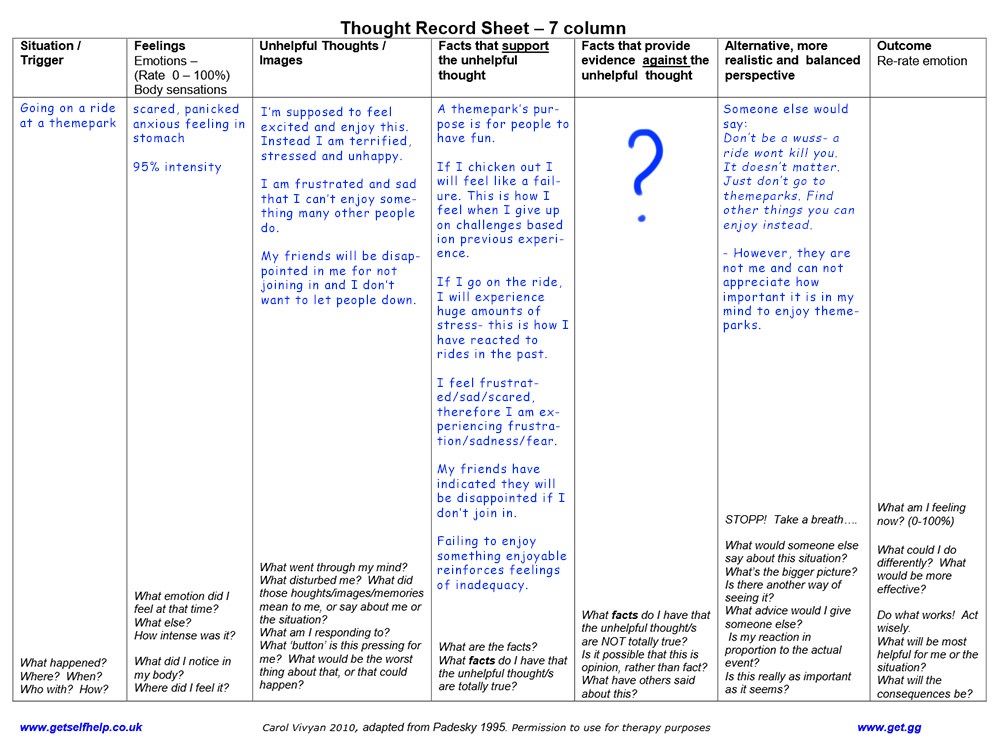 The idea is to record a negative thought process, state facts that justify the thought, facts that don’t, then re-evaluate the thought in a more balanced way. I used theme park rides as an example to fill this sheet out, but I get stuck. It doesn’t make sense to me. It almost feels like I’m being asked to disregard the evidence and first hand experience which generate my current thought processes and be able to invent opposing evidence. Perhaps I need help defining each column or reinterpreting what ‘facts’ mean?