Ocean / Big 5 Personality Model – Old and New

Re-took the test 6 years later. Seems my personality has changed.

Openness to Experience/Intellect

High scorers tend to be original, creative, curious, complex; Low scorers tend to be conventional, down to earth, narrow interests, uncreative.
You are relatively open to new experiences.         

(Your percentile: 65 on 2.4.12)
(Your percentile: 72 on 10.3.18)

Conscientiousness

High scorers tend to be reliable, well-organized, self-disciplined, careful; Low scorers tend to be disorganized, undependable, negligent.
You are well-organized, and are reliable.

(Your percentile: 74 on 2.4.12)
(Your percentile: 76 on 10.3.18)

Extraversion

High scorers tend to be sociable, friendly, fun loving, talkative; Low scorers tend to be introverted, reserved, inhibited, quiet.
You probably enjoy spending quiet time alone.

(Your percentile: 12 on 2.4.12)
(Your percentile: 6 on 10.3.18)

Agreeableness

High scorers tend to be good natured, sympathetic, forgiving, courteous; Low scorers tend to be critical, rude, harsh, callous.
You find it easy to express irritation with others.

(Your percentile: 22 on 2.4.12)
(Your percentile: 25 on 10.3.18)

Neuroticism

High scorers tend to be nervous, high-strung, insecure, worrying; Low scorers tend to be calm, relaxed, secure, hardy.
You tend to become anxious or nervous.

(Your percentile: 66 on 2.4.12)
(Your percentile: 97 on 10.3.18)

Conclusion:

Seems pretty accurate, I’d agree I’m more curious, creative and and intelligent now than I was years ago. A good thing since your brain is supposed to start degrading after your prime years in your early 20s.

I was pretty introvert to begin with and am seemingly more so now. I guess because I’ve spent years getting used to being alone and perhaps growing comfortable with my own company. Perhaps because I worry more, and going out where there’s lots of people around is just too stressful to bother with so I’ve withdrawn some?

But the significant change is obviously the neuroticism. I thought it was bad before but this is just ridiculous! At the same time, it makes sense- I’m constantly depressed, describing myself as someone with ‘Atypical Depression’ (chronic Major depression) and someone who is extremely stress-sensitive. What sucks is, despite my efforts to change over the past 15 years, my personality has remained is pretty ridged, and I find myself in a world which is simply not designed around someone with my mental constituents. Why couldn’t I be more extrovert, more agreeable, less neurotic? Seems people like that get to breeze through life while I must struggle and suffer. It’s frustrating to say “for me life is harder than for everyone else” – sounds like I’m weak or making excuses for being lazy or not putting in effort, but that’s simply not the case. Every day is filled with as much effort as I can muster to better my situation. But there are limits on my effort, energy output and I only have so much time in the day. It also feels like I’m working with an extremely insufficient tool-set. Like a car mechanic that must make do with just a single set of spanners in order to fix an engine.

I would think, for most people, my outlook on life would be completely beyond their comprehension. I would ask them, imagine:

  • Finding very limited enjoyment in anything.
  • Feeling afraid to leave the house and deal with other people
  • Not being able to work a regular job, having to segregate yourself to your home for 90-95% of your existence
  • The work you do at home being massively stressful – putting you on the verge of tears every time you think about starting it or regularly feeling so frustrated with it that you want to throw your computer out the window, then have the ground swallow you up.
  • Feeling that despite giving it 110% effort, you’re able to earn only one fifth of your country’s the average annual salary therefore not cover living expenses.
  • Therefore knowing that normal things you crave, like living in your own home, progressing with relationships, having kids and raising a family is an impossibility.
  • Eating being a hardship- food mostly tasting like eating sand and cardboard
  • Having to sleep 9-10+ hours then feeling tired throughout the day
  • Exercise and working out feeling so exhausting and mentally painful that you often want to cry half way through a session.
  • Feeling insanely guilty that you’re not successful or doing enough despite your best efforts
  • Having few or no good friends you can rely on and feeling alone way too often- even if people are with you, they cannot understand how you feel.
  • Seeing no hope of things improving. Not having a clue how to improve things after having invested massive time and efforts to change things over the years.
  • Virtually nothing to look forward to in life.
  • Dealing with chronic back pain
  • Dealing with chronic eye pain which limits screen time/work time.
  • Dealing with constant chest infections
  • The constant looming presence of existential anxiety

Even if they could imagine, their response would probably be, “well, if I felt those things, this is what I would do…”. But this is the trouble- I am not them! If I was, I wouldn’t have ended up as I am! A part of me doesn’t was to admit defeat, but it seems this is it… This is my life and I have to just carry on dealing with it as best I can. Unfortunately I was dealt a shitty hand I just have to make the best of it.
Highly Sensitive Person: Traits

22 empath traits that might suggest you are a HSP:

1. People point it out

You’ve been told all your life you are too sensitive, overly emotional, or wear your heart on your sleeve. People tell you that you pick up on cues or feelings they don’t even notice.

2. You feel other’s feelings

You’ve noticed how sensitive you are to the emotions of others. Even before they tell you how they are feeling, you already know. You can enter a room and have a sense of the general mood of the environment.

3. Negativity overwhelms you

Where others can tolerate raised voices, conflict, or anger, it sends you over the edge. You almost feel physically sick or in pain as a result of the negative energy around you. You crave peace and calm.

4. Being in crowded places overwhelms you

You don’t like being in malls, sporting events, airports or other public places with crowds of people. You feel suffocated and overly-excited. You can’t wait to leave.

5. Strong intuition

You seem to know things without being told. You sense what needs to be done or what’s about to happen. Your gut feelings nearly always prove to be correct.

6. Pain intolerance

More than others you know, you have a lower threshold for pain tolerance. You can’t stand getting shots, feeling nauseated, or dealing with a minor injury. You may even have had a doctor tell you to stop complaining so much.

7. You must have alone time

You need time every day with no sensory input. You want to withdraw to your room or another quiet place to recharge.

8. You avoid negative media images

You find it extremely disturbing to watch or read about tragic news events or see unpleasant images. It bothers you so much, you avoid looking at these images at all costs.

9. You can easily tell when someone is lying

All you need to do is look at their faces or listen to their tone of voice, and you know instantly whether or not they are telling the truth.

10. You are more sensitive to stimulants/medications

Caffeine in particular makes you more anxious and agitated than the average person. You can never drink caffeine in the evening if you want to sleep. You often have reactions or side effects to medications.

11. You often show up with the symptoms of those around you

If someone close to you is sick or depressed, you will develop the same ailments.

12. You frequently have lower back and digestive problems

These are the result of dealing with negative and stressful situations and people. Your feelings show up as these physical symptoms.

13. You are the dumping ground for the problems of others

People around you seem to gravitate toward you and unload all of their pain and problems on you. Because you are an empath, you feel compelled to help, even to your own detriment.

14. You often feel fatigued

Because others take so much from you, you often feel drained of energy and extremely tired. You might even have chronic fatigue syndrome.

15. You have a very vibrant inner life

You are highly creative, imaginative, and loving. You may be involved in the arts or other creative pursuits. You feel close to animals and especially enjoy your relationship with your pets.

16. You are sensitive to sounds and sensory feelings

Loud noises or sudden dramatic movements startle you. You also feel overwhelmed by bright lights, rough fabrics, and strong smells. You also notice very delicate smells, touch, and sounds.

17. You don’t like too many things at once

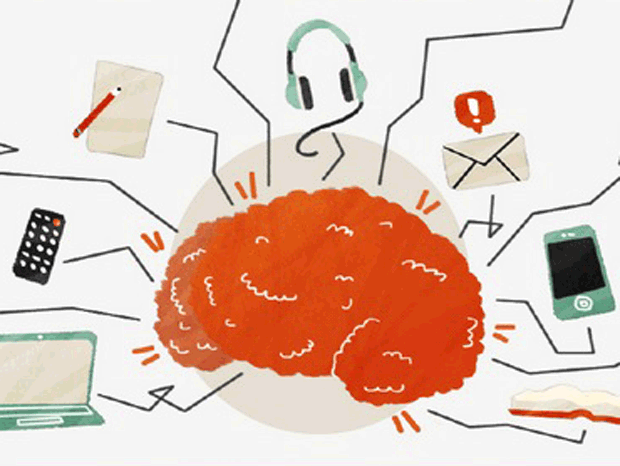
When you have to multi-task or have too much coming at you at once, you feel rattled and overwhelmed.

18. You manage your environment

You create your living and working environment to accommodate your sensitivities. You arrange your schedule and commitments to avoid unpleasant, chaotic, or overly stimulating situations.

19. You don’t like narcissists

You are particularly bothered by people who put themselves first all the time and aren’t sensitive to the feelings of others.  You may even believe there’s something wrong with you or that you have some kind of emotional disorder.

20. You can almost feel the days of the week

Each day of the week has a specific “feel” to it. You notice when a Wednesday feels like a Saturday. You feel particularly heavy at the start of the work week. Even months and seasons have a particular feel.

21. You are a great listener

People tell you this all the time. You listen consciously and know the right questions and comments to draw people out and make them feel heard.

22. You get bored easily

As an empath, you need to focus on work and activities that stimulate your creativity and passion. If you get bored, you resort to daydreaming, doodling, etc. However, you are still very conscientious and try hard to avoid making mistakes

For me, I can totally relate to nearly all of these. 4 outta 5 people will never understand me. I am pissed off because I don’t want to be like this..! But I am, I’ve been like this all my life. No one chooses their genetics. All you can do is play out the hand you’ve been dealt to the best of your ability… And that is what I am doing. My concern now is how I can adapt my life to accommodate my traits. Use my traits to my advantage and succeed in life.

Thoughts about positivity and anxiety

mind puzzleI’d taken a lot of time out from my self development. Life got in the way and I got busy.

Today I sat down to watch a TV Documentary about personalities. It explained theories about why some people are more stressed and anxious than others and how anxiety levels can be changed through mindful meditation and conscious positive focus exercises.

It was another sound bit of proof which contributes to the whole “you get what you focus on in life” theory. Look for the positive and you’ll get it, look for the negative and you’ll get it.

I really want to be more positive and less anxious, but perhaps there’s some kinda reasoning going on in my head which makes me continue worrying about the potential negative rather than instead focusing on the possible positive outcomes. Perhaps subconsciously I don’t want to adjust my mindset?
I would guess my brain thinks that anxiety and negative thinking helps: prepare me better for negative outcome, lets me plan for future events better, the added pressure I give myself can motivate me to avoid potential bad scenarios, allows me to see a more balance view of reality, pushes me to keep standards as high as possible.

Perhaps I secretly fear I would lose the above benefits if I were to be a blind, fuzzy-headed optimist?

OR perhaps my sense of self is too wrapped up in the whole anxiety thing? Maybe leaving a part of myself behind would fuck with my ideas of who I am, my sense of self and leave me without a identity I recognize – This could be one of the biggest obstacles in tackling mental health issues or bad thinking habits or habits in general.

I’m conflicted. I keep fluctuating between valuing happiness as the ultimate goal and maintaining a realistic and balanced view of the world. Can a blind optimist be objective and realistic? Happiness on it’s own won’t put food on the table, prepare me for the future and allow me to survive in an uncertain world. Then again, perhaps being a happier person will be the catalyst for life changes that will allow me to gain more than ever before?

Perhaps when I am ready, I can begin mindful meditation and conscious positive focus exercises with the hope that it will lead me to a better existence?

Multitasking

multitasking“If you’ve mastered the art of multitasking, you probably feel you’re getting more done in less time. Think again, experts say. Research suggests you lose time whenever you shift your attention from one task to another. The end result is that doing three projects simultaneously usually takes longer than doing them one after the other.”

Interesting. It makes sense, but equally if I get stuck or lose enthusiasm for one project, it makes sense to take a break by working on something else until I feel ready to go back to the original task.

As a general new rule, I think I’ll try to multi-task less from now on.

Happiness Article- Remembering to Savour

Happy_DaysThis was emailed to me, so posting it for future reference!…

——————-
There is this puzzle in most Western (and some Eastern) societies
that is really confusing. See if you can figure it out – we’ll use the
United States as an example.

40 years ago…

The average house was 1000 sq feet, now it’s 2422 sq feet
A McDonald’s cheeseburger cost 30 min of wages, now it costs 3 min
There was 1 car for every 2 households, now there are 2 for every 1 household
Life expectancy has since gone up by an average of 8 years
GDP has since tripled or gone up 8.9 trillion dollars
So we live in bigger homes, make more money, and have longer lives.
If that is the case, how can we explain that in the last 40 years:

The divorce rate has doubled
Teen suicide has tripled
Recorded violent crime has quadrupled
And Depression has increased 10x – that’s right ten times.
If things are getting better, why are people getting worse? There isn’t a
one line answer to this paradox, but I’m going to offer a two part theory:
(1) We have been focusing on the wrong things to make us happy; and
(2) When something is wrong (anxiety, panic, depression) we only practice
reducing the negative feelings – we ignore increasing the positive.

Guess what? Happiness doesn’t come from just reducing negative feelings.
In other words, if everything “bad” in your life were wiped away, you would
not automatically be incredibly happy. To live a joyous, fulfilled, and
meaningful life, you need to practice positivity. Yes, happiness takes practice.

One simple practice you can start with is called savoring. If you rush around
all day long from the moment you get up to the moment you hit the pillow, you
are probably not taking time to savor. Slow down and savor the good stuff.
Savoring has been scientifically researched to increase your well-being. Try
the exercise below.

Exercise: According to researcher, Fred Bryant, there are 4 effective
ways to savor:

Basking: Receiving praise and congratulations
Thanksgiving: Experiencing and expressing gratitude
Marveling: Losing yourself in the wonder of the experience
Luxuriating: Engaging in the senses fully

My request of you is that you pick one of these 4 techniques and sit
down to savor right now. Sit down for 5 minutes (if you’re busy,
even 2 minutes will do). Think about one pleasant thing that happened
today (smell, touch, sight, sound, experience) and close your eyes and
enjoy it. Reminisce about what you loved about it.

As humans we are great at doing and moving and pushing through to
the next goal; but we need to also focus on enjoying, savoring, and
just “being”. Remember, happiness takes practice, so make it part of
your day.

Love & Light,

Amelie Chance
Certified Coach of Positive Psychology
——————-

Note: Not to sound cynical and I appreciate the advice but I wonder who certified her? Herself?

Hmm, the art of savouring. It sounds good in theory, but takes effort and a mindset to want to feel good and in the mood to appreciate the good. This is something I’m not naturally comfortable with. I’ll try to savour things more often though if I remember!

The obstacles in fixing one’s life – Sleep issue

sleep-clockI often ask myself  “why is it apparently so much harder for me to do things than other people?

It’s more than a dumb, biased feeling that everyone else manages to sail through life without problems. I don’t want to adopt a ‘Victim mindset’ and I don’t want to make excuses, but it would be dumb not to factor in genuine obstacles I need to deal with or come to terms with in my efforts to progress.

One thing I read up about again recently recently was Circadian rhythm disorders. There are 4 different types- two of which resonate with me:

  • Delayed Sleep Phase Syndrome (DSPS): This is a disorder of sleep timing. People with DSPS tend to fall asleep very late at night and have difficulty waking up in time for work, school, or social engagements.
  • Non 24-Hour Sleep Wake Disorder: This is a disorder in which an individual has a normal sleep pattern, but lives in a 25-hour day. Throughout time, the person’s sleep cycle will be affected by inconsistent insomnia that occurs at different times each night. People will sometimes fall asleep at a later time and wake up later, and sometimes fall asleep at an earlier time and wake up earlier.

According to one site I read:

How Are Circadian Rhythm Disorders Treated?

Circadian rhythm disorders are treated based on the kind of disorder diagnosed. The goal of treatment is to fit a person’s sleep pattern into a schedule that allows him or her to meet the demands of a desired lifestyle. Therapy usually combines proper sleep hygiene techniques and external stimulus therapy, such as bright light therapy or chronotherapy. Chronotherapy is a behavioral technique in which the bedtime is gradually and systematically adjusted until a desired bedtime is achieved. Bright light therapy is designed to reset a persons circadian rhythm to a desired pattern. When combined, these therapies may produce significant results in people with circadian rhythm disorders.

Chronotherapy is something I’ve naturally learned to do myself. I naturally seem to have a 25 hour day, so when I keep going to bed an hour later and getting up an hour later each night to the point where I’m sleeping at 8am and waking at 5pm, I know it’s time to do something about my current sleeping pattern! I commit to what I call “going around the clock”.  Basically it’s a case of trying to stay up later and later each day until bed time goes from 8am to 11am for day 2, to 3pm for day 3, to 6pm for day 4 and so on. It’s a gradual thing that takes at least a week to sort out. In the mean time going to a place of work, enjoying a social life or arranging day-time appointments is very difficult if not impossible. Not only is it very disruptive to day-to day living, but it’s hard work staying awake, and feeling happy when your body is crying out for sleep for 4 or 5 hours towards the end of each day!

I obviously suffer from the symptoms of a Carcadian Rhythm disorder. Perhaps if I can adopt a long term habit of sleeping and waking at the same time each day it’s something I can overcome completely?
– I would probably need a regular 9-5 job, or at least a solid work routine which I don’t deviate from unlike I have done for the last 10 years!

Until then, it’s something I need to deal with, factor into my life and hope other people around me can understand this condition. I fucking hate the thought of people thinking bad of me- that I’m lazy for feeling tired and unmotivated instead of offering understanding and sympathy.

I’ll add CRD to my list of ailments!

Sex Tips from Rock Stars

sexy rock starIn a Men’s Health article I checked out on the subject, they mentioned a few points which are always good reminders of how to present yourself in a more appealing way.  I don’t care about sex tips, but personal development is always good:

  • When in groups, try moving around the room and interacting with as many people as possible. When you speak, vary the pace of your voice from upbeat to slow, and deliver all your words with emphasis. Be controversial, counter-intuitive, emotional and fluent.
  • Recent research found that confident people keep an open posture with their hands apart and away from their face.
  • Rock stars are unattainable. Create that exclusivity by having somewhere else to be and making your time with her feel limited.
  • Guys hunt for women in packs. Women don’t often find that appealing. It’s usually the guy who shows he’s willing to break away who makes the most progress.” Rock legend dictates as much. The successful womaniser breaks away from the entourage, making himself more ‘vulnerable’ by introducing himself to strangers. “You become a much safer proposition,”
  • These are men who stand out: the guy who asks questions during lectures, scores multiple strikes at the bowling alley or takes risks in the boardroom. Find the thing that marks you out – and push it.
  • In a social context, movement is very important. Using expansive arm gestures is a way of getting noticed. Pour cocktails at a party, hail taxis and throw your hands up at gigs.
  • Adopt characteristics that women find attractive: attentiveness, empathy and listening skills [Side note: this is something I’ve worked on a lot and feel very good at]
  • Don’t plan a date for after a heavy workout. Cambridge University found high testosterone reduces your capacity for empathy.
  • Try to look young and youthful- groom yourself (including downstairs)
  • Up your intake of vitamin C. It can prevent the ageing effects of long-term sun exposure, says the University of Maryland.

Although these pointers might just be based on small scale university studies, they make sense and worth keeping stuff like this in mind.

Possible breakthrough for delivering effective therapy

self-understandingI ask myself how come I struggled to find a counsellor, therapist or mental health professional who could understand my problems and deliver an effective, lasting treatment which I felt really helped ME?

[First read about MBTI and Big 5]

I’m noticing the difference between happy INTJs and unhappy ones seems to come down to their Big 5 Emotional stability score. I believe the correlation between these results identifies a very specific sub group of individuals who will all experience very similar problems in life and I begin wondering if there is a specific method for helping these types of INTJs to feel happy and deal with problems? Psychology based therapy generally seems to use a “one size fits all” approach, and I’ve not heard of treatments which are determined and tailored by assessing a combined MBTI and Big 5 score. At this moment, I believe constructing a treatment model with this in mind could make a big difference in how effective therapy and help is to certain individuals.

Currently most therapists assess patients with mood rating tests and leave it at that. Sure- that shows how depressed or anxious someone is, or even filter out issues like compulsive behaviour, but they do not then seem to have a method for treating different personalities from the start, and instead attempt to use a universal rule for treating each patient, or try to figure out how that patient thinks over several sessions, which could be a waste of time and resources. Even after several sessions, that doesn’t mean a therapist would have figured out their patient’s personality, or even know what to do to specifically treat their personality type. I don’t have the answers for treatments for different types, or even my own, but I have learned that people with my personality type will not feel comfortable with someone who can not comprehend our way of thinking, seeing the world and communicating. I wonder if this contributes to why therapy is not always effective and perhaps such assessments could lay the ground work for generally delivering an improved and more efficient mental health service?

Basically- how about treating patients after first assessing their general personality type and using a specific structure of treatment for that type?

If only a psychology team in a hospital could research my idea further to check it’s valid, work out different therapy strategies for the different personality types and then trial this assessment method to see if it had a positive impact.

There may still be a universal rule which would effectively treat nearly all different personality types in one hit, but certainly such a therapy method does not seem to be recognised and used on a wide scale as far am I know. I was informed that a certain scientific test (I’m unable to cite a reference now) proved that a psychotherapist’s treatment is as effective OR LESS than a typical housewife with no experience in psychology and treating patients.

I’ll write more about Anthony Robbins later, but as an example, I believe if the NHS were to treat patients by investing in one his seminars filled with 1000 patients suffering with depression, mood problems, negativity etc, it would be more effective than a dozen individual therapy sessions for each patient. Something needs to change with the current mental health service BIG TIME, that’s for sure!