
What is the point? When life feels impossible.

talent

Not everyone is exceptional

It often seems like it’s excruciatingly difficult to achieve success. You just have to browse social media for 5 minutes to feel like most people are more popular, more attractive or more talented than you are. Not just by a small margin, but by an insane gap that feels impossible to bridge!

Of course, most people aren’t amazing. It’s easy to forget that the “popular” people on social media may be at the top after years of hard graft in improving themselves or attaining a skill worth celebrating. They’re just getting what they deserve from the work they’ve put in, and fair enough. Or it may be sheer luck- they created content, which, for whatever reason, went viral and now they’ve generated a huge following. Or perhaps they’ve just got enough money and resources to buy their way to the top. If such is the case, that doesn’t mean they’re better than you are, does it?

Take solace in the fact that many of us are just regular people who aren’t rich, famous, popular or particularly desirable. But to succeed, achieve things that are significant / worth while, and to be able to compete in the online space (offline too for that matter), you will need to up your game as much as you can. 

There’s a lot of obstacles to contend with

At the end of the day the internet has made it clear that no-matter what you try to get good at, there’s always people just a few swipes away who will make your hard efforts seem futile. Take something like drawing and illustration

. I wouldn’t be surprised if there are at least a few thousand prominent artists alive today who are producing work at an insanely high standard. There is virtually nothing you will ever be able to do to catch up to these people, unless perhaps you’re a child prodigy or you’ve got some extremely rare savant style talents.

Those artists will never struggle to find work, gain popularity or fame if they so wish. In fact, any artists in the top 20% of professional artists will no-doubt take 80% of the top jobs. Big jobs such as an advertisement illustration for, say, Apple, Coke-Cola, or BMW can pay hundreds of thousands of dollars. Then the kudos from being able to write ‘Apple’ as a client on their résumé, means they’ll more likely to continue receiving higher paid jobs from prestigious clients over the coming years too.
Those jobs will never be available to you. Inversely, you may practice your craft for decades and still struggle to pull in a commission from Joe Blogg’s bakery up the street. It doesn’t seem fair. It’s not. Some people, for whatever reason, are destined to succeed at the very top level. The chances are, you won’t.

Normally some motivational speaker or personal development guru will amp you up, help you to believe anything is possible. Sometimes you need that just to get started. Or to at least help you be more productive than you would otherwise be. Although you will unlikely never reach the top if you are also the kind of person who needs to be externally motivated. Those at the top generate motivation from within. They love what they do any cant wait to do it every day of their lives. If that attitude and endless enthusiasm is coupled with raw talent, you have a winner.

So do you give up?

No. Giving up is not even an option. Maybe there’s a time in your life where stopping what you’re doing to change course can be a good idea. Other times, you keep going as best you can.

Sure, most people aren’t exceptional, but there’s enough competition out there already dominating many areas you might try succeed in. Or at least be competent at. You have to find a niche. Something specific which you can concentrate your efforts on which no one else is doing. To use the drawing example again; even if you suck at drawing, perhaps there’s a way to be the best damn stick figure artists there is! Seriously. If you’re the go-to artist for fun, funny or quirky stick figure art, you may even be able to achieve more than the next artist who spends hours every day attempting to figure out drawing anatomy or mastering perspective.

Find your niche and compromise.

And then you need to be cool with it. You have to admit to yourself and others that you tried your best and couldn’t cut it. You simply weren’t able to become technically proficient at drawing in the way you initially hoped for. But there’s no shame in that. Accepting your limitations might just be the one thing to help bring peace to your life.

It seems hard. Impossible. It’s not easy, but it’s not hopeless.

Melancholic Me

When something is so true it makes you laugh! – This is me. It’s one of four Temperaments.

“The Four Temperaments personality system attempts to describe a person’s overall attitude towards problems, other people, and life in general in a very broad way. They aren’t meant to describe every detail of a person, such as their favourite flavour of ice cream or their mother’s maiden name; rather, they just describe a person’s overall attitude.”

And so, I discovered I have the ‘Melancholic’ temperament…


In a nutshell…

Melancholic people are emotionally sensitive, perfectionistic introverts.

Perfectionistic

The defining feature of a melancholic attitude is perfectionism. They are idealists who wish for things to be a certain way, and they get distressed when they are not.

They hold themselves and others to unrealistically high standards, and get distressed when these standards are not met. 
This leads to them being self-deprecating – because they do not meet their own standards – and critical of others – because those others do not meet their standards.

Their generally dour demeanour comes from their inner struggle between an imperfect world and a desire for perfection.

Many melancholics wish to learn and to understand, to know the details of every little thing, because to be ignorant is to stray from perfection. They are not content to just accept things the way that they are. 
They are inquisitive and ask specific questions in order to come to a clearer understanding.

This leads many of them to be overanalytical, neurotic worriers.

They are very stubborn, because they try very hard to stick to their own carefully considered views and standards of perfection, and are not easily shifted from this path. They do not go with the flow.

They are tenacious and cannot let things go, because ‘good enough’ is not good enough. They strive for perfection.

They are very pessimistic, and assume the worst due to these unrealistic standards.

They think and plan before they act; they are not the types who will resort to rash, impulsive behaviour, and will panic if they are unable to plan in advance.

It’s easier for them to reject and hate things than it is for them to love and embrace them. Their interests and tastes are picked carefully, and they give a lot of attention to each one, and hold them close to their hearts, rather than having many fleeting interests that change quickly and often.

They complain a lot, in a ‘whinging’ kind of way rather than a ‘put down’ or ‘demanding’ kind of way.

They tend to argue, because they cannot simply let things be if they seem wrong. They argue using reason, evidence, logic, and explanations, delivered analytically or with pleading. They only argue to set wrongs right, rather than to assert dominance. The argument is about the issue, not about them.

They respond poorly to compliments, often ‘rebutting’ them by saying that they’re not so great after all. 
“Wow, that’s a really nice painting you just made!” 
“I don’t know, the eyes are probably too big…” (rather than “Thanks!”)

They will blame themselves for mistakes, because they are acutely aware of their own imperfection.

They tend to prefer things to be tidy, organised in some way or another. This doesn’t necessarily mean ‘neat’ as such; often they have very idiosyncratic organisation methods.

They are idealists, who imagine perfect fantasies and feel upset when things don’t live up to these fantasies.

They prefer to tackle the heart of the matter, which can lead to them avoiding ‘beating around the bush’.

Introverted

Melancholics are the most introverted of the temperaments in that they crave time alone, and are most at ease in their own company.

They can enjoy spending time with others, but this drains their energy, and they need alone time in order to recharge.

Much of their introversion comes from their perfectionism. They are picky about the sorts of people that they associate with; people who meet their standards and share their outlook. People that don’t will make them uncomfortable; they do not wish to talk to ‘anyone and everyone’. 
Their self-deprecation also makes them think that they might not be very interesting anyway, that they aren’t really worth spending time with, even if they know in the depths of their minds that they are very interesting indeed.

Once they have someone to talk to in a quiet and relaxed environment, they can talk a lot and will enjoy sharing thoughts and ideas.

They are very wary of making friends. Unlike sanguines, it can take them a very long time for them to consider someone they’re familiar with a ‘friend’, but once they’ve reached this point, they will likely stick with that person loyally.

They prefer having a few close friends to many acquaintances.

They can be seen as selfish, because they prefer to be alone with their thoughts, to have their own things, rather than sharing time or possessions socially with others. 
They are usually very possessive about the things that they own and are reluctant to let others borrow or use them, because they treat their own things well, care about everything deeply, and will worry that others will not look after them with the same level of care.

They could be described as ‘intense’, rather than ‘easy-going’.

Sensitive

Melancholics are very emotional. They are moved deeply by beauty, and by distress. They are very easily hurt, because of their perfectionistic tendencies. 
Often their moods are like delicate glass sculptures; built up slowly, deliberately, and carefully, but easily broken, and hard to repair once shattered.

They respond to things that they dislike with misery and with tears rather than with rage.

They are very slow to ‘snap’, but will hold onto emotions for a very long time. They hold grudges, because people who have failed to meet their standards, who have hurt them, will not just suddenly meet those standards without changing drastically.

They can become very ‘moody’, and they can be difficult to interact with because they are so easily hurt.

They are not aggressive, and wish to flee from things that cause them distress.

If they want to get back at another person, they are more likely to make them feel guilty than to insult them bluntly.

They are ‘thin-skinned’.

Role

In our distant ancestors, the melancholic members of a pack may have been the analysts, the information gatherers. They scouted for potential danger, or for food, and reported back to the pack leader. The more accurate their findings were, the better; this led to a trend towards perfectionism, as the ‘analysts’ closer to perfection survived better than those that made sloppy mistakes.

In current society, they often tend towards analytical roles such as scientists, analysts, programmers, logicians, and so on. In fantasy settings, they may be wizards or sages.

Ocean / Big 5 Personality Model – Old and New

Re-took the test 6 years later. Seems my personality has changed.

Openness to Experience/Intellect

High scorers tend to be original, creative, curious, complex; Low scorers tend to be conventional, down to earth, narrow interests, uncreative.
You are relatively open to new experiences.         

(Your percentile: 65 on 2.4.12)
(Your percentile: 72 on 10.3.18)

Conscientiousness

High scorers tend to be reliable, well-organized, self-disciplined, careful; Low scorers tend to be disorganized, undependable, negligent.
You are well-organized, and are reliable.

(Your percentile: 74 on 2.4.12)
(Your percentile: 76 on 10.3.18)

Extraversion

High scorers tend to be sociable, friendly, fun loving, talkative; Low scorers tend to be introverted, reserved, inhibited, quiet.
You probably enjoy spending quiet time alone.

(Your percentile: 12 on 2.4.12)
(Your percentile: 6 on 10.3.18)

Agreeableness

High scorers tend to be good natured, sympathetic, forgiving, courteous; Low scorers tend to be critical, rude, harsh, callous.
You find it easy to express irritation with others.

(Your percentile: 22 on 2.4.12)
(Your percentile: 25 on 10.3.18)

Neuroticism

High scorers tend to be nervous, high-strung, insecure, worrying; Low scorers tend to be calm, relaxed, secure, hardy.
You tend to become anxious or nervous.

(Your percentile: 66 on 2.4.12)
(Your percentile: 97 on 10.3.18)

Conclusion:

Seems pretty accurate, I’d agree I’m more curious, creative and and intelligent now than I was years ago. A good thing since your brain is supposed to start degrading after your prime years in your early 20s.

I was pretty introvert to begin with and am seemingly more so now. I guess because I’ve spent years getting used to being alone and perhaps growing comfortable with my own company. Perhaps because I worry more, and going out where there’s lots of people around is just too stressful to bother with so I’ve withdrawn some?

But the significant change is obviously the neuroticism. I thought it was bad before but this is just ridiculous! At the same time, it makes sense- I’m constantly depressed, describing myself as someone with ‘Atypical Depression’ (chronic Major depression) and someone who is extremely stress-sensitive. What sucks is, despite my efforts to change over the past 15 years, my personality has remained is pretty ridged, and I find myself in a world which is simply not designed around someone with my mental constituents. Why couldn’t I be more extrovert, more agreeable, less neurotic? Seems people like that get to breeze through life while I must struggle and suffer. It’s frustrating to say “for me life is harder than for everyone else” – sounds like I’m weak or making excuses for being lazy or not putting in effort, but that’s simply not the case. Every day is filled with as much effort as I can muster to better my situation. But there are limits on my effort, energy output and I only have so much time in the day. It also feels like I’m working with an extremely insufficient tool-set. Like a car mechanic that must make do with just a single set of spanners in order to fix an engine.

I would think, for most people, my outlook on life would be completely beyond their comprehension. I would ask them, imagine:

  • Finding very limited enjoyment in anything.
  • Feeling afraid to leave the house and deal with other people
  • Not being able to work a regular job, having to segregate yourself to your home for 90-95% of your existence
  • The work you do at home being massively stressful – putting you on the verge of tears every time you think about starting it or regularly feeling so frustrated with it that you want to throw your computer out the window, then have the ground swallow you up.
  • Feeling that despite giving it 110% effort, you’re able to earn only one fifth of your country’s the average annual salary therefore not cover living expenses.
  • Therefore knowing that normal things you crave, like living in your own home, progressing with relationships, having kids and raising a family is an impossibility.
  • Eating being a hardship- food mostly tasting like eating sand and cardboard
  • Having to sleep 9-10+ hours then feeling tired throughout the day
  • Exercise and working out feeling so exhausting and mentally painful that you often want to cry half way through a session.
  • Feeling insanely guilty that you’re not successful or doing enough despite your best efforts
  • Having few or no good friends you can rely on and feeling alone way too often- even if people are with you, they cannot understand how you feel.
  • Seeing no hope of things improving. Not having a clue how to improve things after having invested massive time and efforts to change things over the years.
  • Virtually nothing to look forward to in life.
  • Dealing with chronic back pain
  • Dealing with chronic eye pain which limits screen time/work time.
  • Dealing with constant chest infections
  • The constant looming presence of existential anxiety

Even if they could imagine, their response would probably be, “well, if I felt those things, this is what I would do…”. But this is the trouble- I am not them! If I was, I wouldn’t have ended up as I am! A part of me doesn’t was to admit defeat, but it seems this is it… This is my life and I have to just carry on dealing with it as best I can. Unfortunately I was dealt a shitty hand I just have to make the best of it.

Working with what you’ve got

I’ve spent years now sucking up knowledge, first from books, then from the internet. I still can’t get enough of intelligent scientists, thinkers, authors and communicators who consistently enlighten me to things I’d otherwise never find out.

While there may not be answers to all life’s questions available to us, there’s now enough content in the world to get a really good grasp about current, optimal ideas: Best ways to improve confidence, health, a skill, or answer the questions of why an aspect of life or the universe is the way it is.

For those interested in improving their lot, which is most of us, the knowledge is now out there and easily accessible providing you spend a little time finding out where to look.

People are now smarter, or should I say, more informed than ever. I’m more informed. It’s great! However, people like my parents who aren’t interested in learning, those who also rely or lower quality info (e.g TV) to stay informed, or those who have skewed biases based on bad life experience are stuck. These people will always be limited in their breapth of knowledge.

So far as living thinkers / idea communicators goes; I’ve read books about certain scientific concepts from the likes of from David Doitch. Mindfulness from Ekhart Tolle. Ideas on philosophy from Sam Harris. Self optimization from Tim Ferris and Tony Robins to name a few. So despite all my new found knowledge, why do I still fail in many areas of my life?

This is the key question I battle with. Knowledge is interesting, satisfying, and can be immensely useful. However it seems one or two things are true:

  1. I am not applying it to my life. or
  2. I am not able to apply it.

I’m suck in habits. I’m set in my routine, so I need lots of reminders to do new things and why to do them. Even if I’ve read or learned about a thing several times already. I still need a supply knowledge, although now more as a prompt and reminder than to be enlightened. But when I am prompted, why do I resist utilizing the knowledge to make a change in my life? I often don’t apply these things because I have resistance, conflicts or face certain obstacles. Authors and talkers (especially those of the personal development variety) don’t take in to account.

For example:

Eatting healthy. I know I should be eating a balanced diet. I know what that looks like. I even know the best types of meats, vegetables, carbs and fats to consume, including the science behind why certain foods win over others! But I can only keep it up a diet for 2 or 3 days before I struggle. There are obstacles to deal with:

Taste: The taste often causes me to gag. Just the thought of certain foods (Salmon and Cauliflower in my case) makes me feel genuinely sick even though I know they are really good for me. It’s so boring to eat, it becomes stressful and you feel you’re missing out on life’s pleasures!

Purchasing Logistics: Buying fresh veg etc. is somewhat difficult as I don’t have any local grocery stores near me and so takes time out of my week to constantly shop for fresh produce. Time I don’t want to sacrifice.

Time Consuming: I find preparing food to be a boring and time consuming chore. Even eating a ton of veg is time consuming!

Cost: Healthy food is often really expensive- I can’t afford quality Tuna Steak and broccoli sprouts regularly. Plus I’d feel it’s wasteful to throw out my current pantry of food and replace with healthy.

Battle of Addiction: The craving for shitty food becomes distracting and overwhelming so can’t concentrate and puts me in a bad mood. Becomes difficult to stay on the wagon if eating out or occasions where you’re being cooked for. I don’t have enough positive things going on in my life to feel I can sacrifice the foods I enjoy or can tolerate.

I do well to make the compromises I do- to limit the amount of crisps, cake and ice cream. I’d eat that shit all day long if I couldn’t control myself at all. But still, my point is, from the starting position I’m coming from simply eating healthy is much, much easier said than done.

It’s not just diet I’m currently failing at. I’m 34 going on 35 and yet:

  • I still live at home with parents
  • I have no one in my life I can socialize with on my level
  • The one friend I am currently speaking to is the type others would describe as ‘toxic’ and should ditch
  • I’m extremely isolated. Half the week I don’t leave the house. When I do I don’t talk to anyone.
  • Always been a bit of a loner. I like being on my own to a degree, making it difficult to potentially start relationships with people
  • I’m not particularly likeable. Negative. Always want things on my terms
  • Socially anxious to the point of selective mutism in groups
  • I’m unlike most people, with unique interests, thoughts and ideas others often can’t relate to
  • I’ve no job, never really had a full time job for longer than 3 months.
  • Poor work ethic. Having never developed the habit of working hard consistently.
  • I’m unqualified to work nearly all ‘professional’ jobs
  • Stress sensitive causing bouts of extreme depression and anxiety if small bad things happen
  • Not super handsome. Physically average at best.
  • Constantly frustrated about all of the above. Also generally don’t enjoy life on the whole.

While it’s great to have the knowledge and wisdom of a 34 year old, I’m arguably in a worse position to set out on my journey to thrive in this world than an average guy entering his 20s. Even if I could somehow adopt all the new habits and lifestyle changes necessary to become more ‘whole’, I’d need to give up 90% of myself and current lifestyle which is a huge ask.

The guy described above in those bullet points is a guy who’s massively broken. To expect a quick fix or to simply adopt a new lifestyle or way of being is out of the question. You don’t go from being a guy who hates and fears social engagements to the point of them making him ill, to becoming someone who’s life and soul of the party, who’s charming, brimming with confidence, who comfortably deals with public speaking and meeting new people.

Therefore a unique strategy needs to be implemented in order to overcome life’s challenges and make the most of opportunities available. What will this strategy be?

While I’m in a contemplative mood…

Right now, I feel as though I have a brief window to self-analyse before distractions take over and force me back to a mental state of mindlessly reacting to whatever is at hand…

I started today waking up, then finishing reading ‘Waking up’ by Sam Harris. An interesting, thoughtful book worth a second run. It makes me once again re-think about consciousness and who am I.

As I understand it, I am my awareness / consciousness. I am also, or at least have become, the content of my life- Content (thoughts, memories, opinions, preferences and in other words, ego) which makes me unique and gives me identity. Although perhaps ownership of an identity / ego is not something worth nurturing or holding on to? And perhaps that is because the content in one’s life changes over time and lacks lasting significance? New experiences take place, new beliefs form and you never stay the same. You become a different person over time. Although not entirely different. Some early experiences will most likely remain indefinitely, while physical attributes, such as eye and skin colour will most definitely remain though out life…

It would seem that the content part of one’s life can often be a cause of misery and acts like meditation are said to provide relief from pain by detaching from the thoughts and ego by simply observing them. I also wonder if there is a way to actively shape one’s content, and so then alter beliefs, thought patters and the identity I’ve acquired? And is that even a goal worth pursuing?

I suppose many people already shape the content of their brains, for example, when they travel to a new place and experience a new way of life, temporarily abandoning their familiar routines / lifestyle and instead see the world differently. Is that why people like to travel? To actively broaden their horizons and give their brains new content to work with? I’ve always thought that it would be all good and well for me to replace my external environment for another, but I will surely still have the same filter in my brain which will only allow me to interpret much of my subjective experience in a negative way, whether I am at home, in a foreign country or living on the moon.

There is truth to the fact that I unknowingly cling to my established thought patterns wherever I go. I can’t escape them just be moving house or being in a different place. I’ve tried it. While the novelty of a new environment does bring about a temporary positive change in mood, it seems to gradually fade over a month or two after getting used to it. I don’t know how much of the positive effect of having re-located permanently remains? Perhaps some, or none, and the only solution might be to continually travel and experience new things or ideas before boredom or a negative outlook has time to catch up?

On a neuro-scientific level, I suspect that being in a new place and experiencing something new causes new synaptic pathways in the brain to form, effectively altering who you are. That is the goal. But to first let go of old, limiting self beliefs, and adopt positive new ones may not be as simple as throwing yourself into a new, unfamiliar situation. And even if it was, retaining the new outlook and not reverting back to the old once familiarity with the new setting kicks in would be a challenge. I’m sure in the future it will be possible to selectively and permanently alter parts of the brain in order to give someone a person a personality make-over. Both a scary and exciting possibility. If such is possible, it does make me then question who I am and what is the significance to any aspect of my identity?

This is interesting to think about and something that I feel everyone needs to consider to avoid simply existing, like an ant- just carrying out it’s genetically pre-programmed routine and being reactive to whatever appears in it’s path. I view most people like ants. I myself behave link an ant, but at least I have the insight to realize what I am.

While profound insights about one’s self are important, so is survival, and so is happiness. As a mere mortal human governed largely by human needs and instincts, I don’t feel I can neglect my external life. For my own physical and immediate mental well-being, I need to: work, form relationships and alliances, be part of society and increase my status within society or those around me by demonstrating or providing value, seek enjoyment.

In some ways I would be scared to throw out my identity. Although I struggle to fit in, I have discovered small pockets of people who appreciate my unique qualities and preferences. I’m concerned about the possibility of changing who I am to the point of abandoning these people and potentially making me even more obscure and less likable. I’ve found ways which help manage my unfortunate stress intolerance- while getting out of my routine sounds like it could be just what I need, could it make things worse and cause excessive or physiological and mental anguish? I’d have to start over from scratch- crafting a new life and having no affinity to anyone or any thing.

In the real world, I guess unless I suffer from retrograde amnesia, a part of my identity will most likely always remain, even if I make active efforts to change my life / the way I think. I wonder Is there is a way to selectively pick the parts of your identity to keep or discard? Maybe the idea is to just see and experience as much of everything as you can and your subconscious will work that out for you?

Creating a Personal, Private Time Line

I’ve had the idea for 4 or 5 years to create a time line project– similar to Facebook’s time line by utilizing all the data I’ve accumulated about myself and my life over the years. It wouldn’t necessarily be a public article and not constructed off the back of Facebook’s selective data mining. It would effectively be an image of my life and existence to demonstrate to myself and potentially others how I’ve lived, what I’ve done, who I am.

I thought it was pretty coincidental that Microsoft are apparently now interested in developing an automated time line project.

The best solutions for creating a personalized timeline project I’ve found online are:

  1. Timeline by Knightlab
  2. Time Glider

Tiki Toki Seems perfect for my needs and looks great but requires a subscription to embed a timeline on a web page. $7.50 a month isn’t too bad, but over the course of the rest of my life time, keeping a timeline up is going to set me back over $5,000! Whereas a one-time fee of say $50 would be much more in line for a piece of software like this. In fact I discovered there is a Desktop version of the software for $24.99. The only trouble is, it doesn’t allow times lines to be displayed or exported to the web. Frustrating to find a perfect solution with totally unreasonable and affordable costs.

Dipity Seemed Ok at first glance until I realized a subscription was required to input over 150 Events. And like with Tiki Toki, you then have to pay extra to remove ads.

The aim would be to include:

  • Life Events: E.g: Certain birthdays with photos, Holiday with photo, video or links to image galleries
  • Achievements: E.g: Passing my Driving test along with a photo of my first car
  • Extracts and text from from Blog entries and Key documents
  • Music Collection: Dates I’d discovered favorite songs or artists + Audio
  • Day trips or other interesting things with links to photos galleries for these / or thumbnail galleries
  • Friendship markers: First becoming friends with X, Y or Z with links to photos of them over the years
  • My Art created
  • Jobs Started with examples of work created at jobs / thoughts about the job
  • Key Purchases: Including reviews, pics or links to product info
  • Maybe things like ‘Wrote first CV’- and a link to it, plus link to my latest CV?

I also want to include data such as:

  • The folders I have containing pics I like : Maybe link to Pinterest or Alternative hosted galleries?
  • List of things I’m a fan of with links to relevant articles and media.
  • Collection lists (games [Grouvee], movies [Flixster], anime with ratings) Perhaps using Collectorz (Although it’s Paid Desktop version or Online Subscription)
  • Funny things I’ve found
  • Links to related online content- social media and web sites (if timeline separate from my home page)
  • This would probably be separate from the Timeline but be part of an overall ‘My Life’ package.

Group situations: Social Anxiety

Social-groupI’ve identified 3 reasons why I hate group situations so much:

1. Feeling like others will judge you negatively if you speak

So you keep quiet. Maybe after 10 minutes of self talk, you pluck up the courage to say something, but because you aren’t part of the group’s conversational flow, it often kills the conversation dead and draws uncomfortable attention to you. Others might then want to avoid you speaking and disrupting their flow in the future by not give you chance to talk by asking you questions or looking in your direction for input. Also by not speaking, you aren’t asserting your dominance and people will be less respectful of you and your opinion even if you did decide to pipe up. Either not wanting to hear what you say or being dismissive, which would then cause you even more withdrawal. And if others feel you have adopted the conversational role of ‘listener’, they may either think you want them to be the ‘speakers’ so not giving you cue to talk or asking you questions.

2. Promotes self-hate from not meeting performance standards

I have this idea in my mind of being a cool guy. Someone with interesting or funny things to say, who can lead a conversation or at least participate in equally with others. When there’s this fear of being judged, it’s hard to talk in case you say someone that offends, hurts, irritates, or bores. The chances are that if you’re in a group of people, 1 or more probably will disagree or feel bored. However, I have this unreasonable expectation to please everyone and don’t know how. So I end up withdrawing. Rather than leading or participating in an enthralling conversation, I sit in the corner completely mute. I don’t say a single word for hours on end and I hate myself for it.

3. Boredom

Listening to other people’s conversations can occasionally, for a short time be interesting. But after 10 minutes, if I’m not experiencing any interaction, boredom kicks in. If I am in a group, it’s usually with people I don’t know very well. So they will talk about stuff I can’t relate to or aren’t interested in. Listening to mundane topics you don’t like, about people you don’t know or situations you haven’t experienced and don’t care about is excruciatingly boring. Unfortunately I don’t drink or do drugs, so can’t even use that as an escape as others might do.


I come away from most group chats feeling depressed and drained. It’s exhausting listening to others as intently as I do for hours on end and not getting a break by speaking or expressing myself. It reinforces my negative opinions of people; how I feel I don’t fit in or can’t perform. I’m annoyed at how I’ve wasted my time by being a spectator to other’s conversation that I couldn’t get anything out of, couldn’t participate in and couldn’t leave a positive impression. While I may not have looked like a complete dick-head, I am aware of the fact I added zero value to the group and now people have the opinion that I am quiet, don’t like talking, don’t contribute or can’t, am pretty boring or useless. This kills my self esteem, adds to feelings of worthlessness, making future group chats even more of a struggle. A perpetual downward cycle of trying, failing, being worse off.

Possible Solution

Don’t even bother with group meets unless you have a game plan and enough mental energy to implement it:

Focus on the goal of holding a conversation for even just 1 minute. Forget how you may be perceived, if you may look like a dick, if you might be boring. Chances are you won’t annoy, but even if you do, it doesn’t matter and you know from experience that no-one else will be giving a shit if they’re boring or annoying in conversation. Before attending, you know in you mind the only point of you being there is converse, for say, 1 minute and not allow the conversation to stop or be diverted away from you or your topic of discussion. It will be a life or death decision to assert, dominate or be equally in control for at least 1 minute. Any more is a bonus, but you will get that 1 minute of chat where you are constantly interacting, and making sure you are heard and listened to while speaking. You won’t fail because you agreed to the group meet, knowing before-hand that will have your game plan and enough energy to implement it.

The group meet is now an opportunity to complete your goal. Nothing else matters. How it might be, where it might be, who might be there and what might be said, or how you might look weird or awkward doesn’t matter because your only focus is your 1 minute conversational goal. And getting stuck in towards the beginning of the meet up is important to help complete the goal. It gets it out the way and shows everyone you are there to be listened to before you are assigned the ‘quiet listener’ role.

See how it goes. Perhaps next time you can assign yourself three 1 minute occasions during the meet where you will dictate the topic of conversation, speak about yourself or hold the conversation.

Listing Habits to change

I thought it would be a good idea to list off stuff I do which could be considered negative or impacts my life in a negative way, and the positive to changing…

Lack of sleep routine: A better sleep time (e.g. 1pm-10am) = Being much more alert and ready for appointments the following day, getting some sun light during daytime, yet still allows for quite time at night, miss rush hour traffic

Wake resistance: Getting up after 8-9 hours of sleep should be more of a matter of urgency to start the day and move towards the things I would like to achieve.

Oversleep: More time to live, less guild while awake, prevents over-tiredness.

Excessive Porn: Not a constant issue, but removing these episodes and cutting down on hot girl browsing on social media sites (self distracting) and clip surfing would free up time for producing and creating.

Not monitoring RnR time: before starting a run of video watching, a game, series or socializing, allot time to: prevent spending all day/night getting distracted, carried away, fuck with sleep and work routine, remove over-indulgence guilt.

Feeling like I deserve excessive rest after work: Rest, sure. A 5 hour TV stint while eating junk food, should be avoided most times and would allow free up time for producing or if energy low, time for simple chores like cleaning, planning, marketing

Irregular meal times and eating unhealthy food: More energy and focus, better physique, reduce fat around organs, less guilt, better mood

And the habits I’ve cultivated and wish to keep

Gym / work out 2-3 times a week: High intensity strength training.

Daily Higher Protein intake: whey drinks morning and night.

Daily High strength Omega 3, Vitamins and minerals

Being reasonably clean and tidy: Clean environment, clean mind

Meet / hang out with my brother 1-4 times a month

Never be in debt: Always have credit and a safety net

Be considerate towards others: Don’t be an arsehole

Highly Sensitive Person: Traits

22 empath traits that might suggest you are a HSP:

1. People point it out

You’ve been told all your life you are too sensitive, overly emotional, or wear your heart on your sleeve. People tell you that you pick up on cues or feelings they don’t even notice.

2. You feel other’s feelings

You’ve noticed how sensitive you are to the emotions of others. Even before they tell you how they are feeling, you already know. You can enter a room and have a sense of the general mood of the environment.

3. Negativity overwhelms you

Where others can tolerate raised voices, conflict, or anger, it sends you over the edge. You almost feel physically sick or in pain as a result of the negative energy around you. You crave peace and calm.

4. Being in crowded places overwhelms you

You don’t like being in malls, sporting events, airports or other public places with crowds of people. You feel suffocated and overly-excited. You can’t wait to leave.

5. Strong intuition

You seem to know things without being told. You sense what needs to be done or what’s about to happen. Your gut feelings nearly always prove to be correct.

6. Pain intolerance

More than others you know, you have a lower threshold for pain tolerance. You can’t stand getting shots, feeling nauseated, or dealing with a minor injury. You may even have had a doctor tell you to stop complaining so much.

7. You must have alone time

You need time every day with no sensory input. You want to withdraw to your room or another quiet place to recharge.

8. You avoid negative media images

You find it extremely disturbing to watch or read about tragic news events or see unpleasant images. It bothers you so much, you avoid looking at these images at all costs.

9. You can easily tell when someone is lying

All you need to do is look at their faces or listen to their tone of voice, and you know instantly whether or not they are telling the truth.

10. You are more sensitive to stimulants/medications

Caffeine in particular makes you more anxious and agitated than the average person. You can never drink caffeine in the evening if you want to sleep. You often have reactions or side effects to medications.

11. You often show up with the symptoms of those around you

If someone close to you is sick or depressed, you will develop the same ailments.

12. You frequently have lower back and digestive problems

These are the result of dealing with negative and stressful situations and people. Your feelings show up as these physical symptoms.

13. You are the dumping ground for the problems of others

People around you seem to gravitate toward you and unload all of their pain and problems on you. Because you are an empath, you feel compelled to help, even to your own detriment.

14. You often feel fatigued

Because others take so much from you, you often feel drained of energy and extremely tired. You might even have chronic fatigue syndrome.

15. You have a very vibrant inner life

You are highly creative, imaginative, and loving. You may be involved in the arts or other creative pursuits. You feel close to animals and especially enjoy your relationship with your pets.

16. You are sensitive to sounds and sensory feelings

Loud noises or sudden dramatic movements startle you. You also feel overwhelmed by bright lights, rough fabrics, and strong smells. You also notice very delicate smells, touch, and sounds.

17. You don’t like too many things at once

When you have to multi-task or have too much coming at you at once, you feel rattled and overwhelmed.

18. You manage your environment

You create your living and working environment to accommodate your sensitivities. You arrange your schedule and commitments to avoid unpleasant, chaotic, or overly stimulating situations.

19. You don’t like narcissists

You are particularly bothered by people who put themselves first all the time and aren’t sensitive to the feelings of others.  You may even believe there’s something wrong with you or that you have some kind of emotional disorder.

20. You can almost feel the days of the week

Each day of the week has a specific “feel” to it. You notice when a Wednesday feels like a Saturday. You feel particularly heavy at the start of the work week. Even months and seasons have a particular feel.

21. You are a great listener

People tell you this all the time. You listen consciously and know the right questions and comments to draw people out and make them feel heard.

22. You get bored easily

As an empath, you need to focus on work and activities that stimulate your creativity and passion. If you get bored, you resort to daydreaming, doodling, etc. However, you are still very conscientious and try hard to avoid making mistakes

For me, I can totally relate to nearly all of these. 4 outta 5 people will never understand me. I am pissed off because I don’t want to be like this..! But I am, I’ve been like this all my life. No one chooses their genetics. All you can do is play out the hand you’ve been dealt to the best of your ability… And that is what I am doing. My concern now is how I can adapt my life to accommodate my traits. Use my traits to my advantage and succeed in life.

Current Goals

I’m basically achieving a lot of what I need right now:

  • Book Work
  • Gym/Exercise 2-3 times per week
  • Tattooing once a week
  • Social contact with a few friends throughout the week

It’s all day to day stuff. I’d like something else to aim for- an art exhibit or something? Feel inspired to create more art and try out some different styles etc

Content consuming

todays-definition-of-online-contentThere’s too much stuff on the internet! Too much stuff in the world! It blows my mind and makes me confused. It’s impossible for me to ‘learn the internet’ or consume the net in its entirety! But I kinda wish I could…

I want to consume content I’m interested in and that will benefit me. I like lot of things and for each thing I like there is a near endless supply of related content available. What do I do about that?

How to I feed my content addiction? And without spending every waking hour of my life trying to consume everything ever recorded on my topics of interest!

I need a filter. And how do I ensure I filter the best/most relevant content?

Google searching is a good start for certain content but also often inefficient. It seems to generate so much crap I have to wade through or deviate around before I can find genuine high quality content. I often give up before I even discover it.

What is the answer to the problem of content addiction?

Therapist Session #6 of 6

therapy-doneI’ve finally finished my six session NHS therapy.

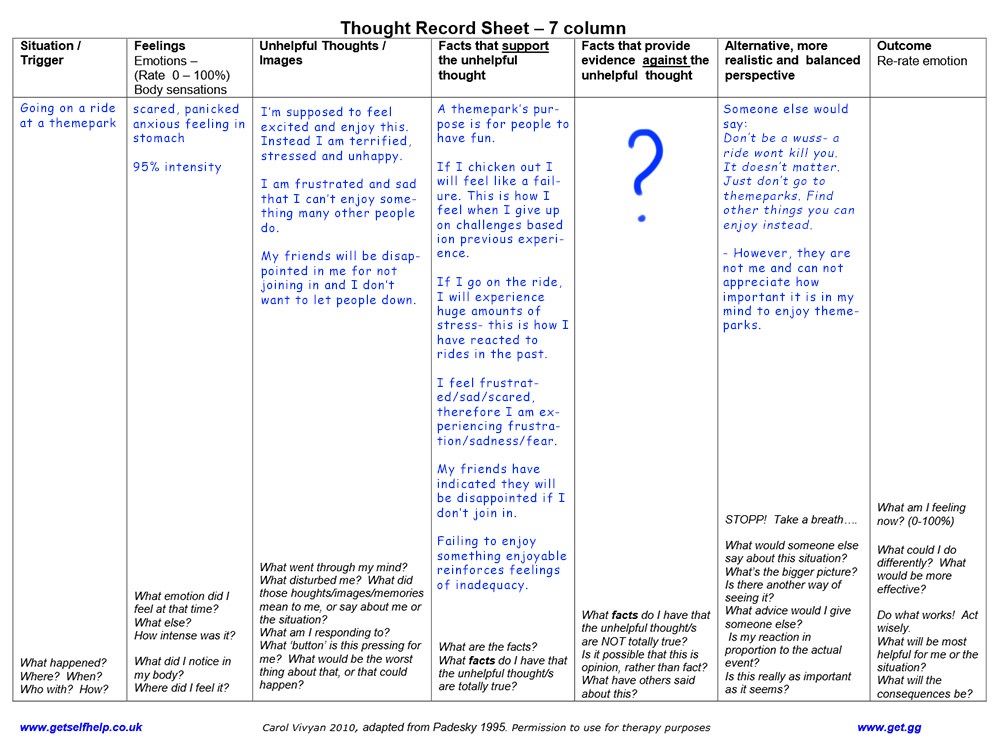
3 sessions with one therapist- an older, intelligent lady who offered a few insights but ultimately became frustrated that I couldn’t/wouldn’t fit her CBT molds or models and was unable to relate to her diagrams of how I supposedly think.

3 sessions with another lady. She was nice and more focused on the idea of acceptance rather than change. Throwing the idea of mindful meditation into the mix as homework.

6 one hour long sessions were barely enough to touch the sides, but that’s all you get unless able and willing to go with private treatment. It proved to be a small help while it lasted- offering a forum to consider myself and my mind, but certainly not life changing. Fortunately I wasn’t relying on it helping too much and it met my low expectations.

One big problem I still have with conventional therapy / CBT are ‘Thought records’ like this one:

ThoughtRecordsheetmock1The idea is to record a negative thought process, state facts that justify the thought, facts that don’t, then re-evaluate the thought in a more balanced way. I used theme park rides as an example to fill this sheet out, but I get stuck. It doesn’t make sense to me. It almost feels like I’m being asked to disregard the evidence and first hand experience which generate my current thought processes and be able to invent opposing evidence. Perhaps I need help defining each column or reinterpreting what ‘facts’ mean?

Completing the sheet might be pointless anyway if I doesn’t actually help me make any lasting positive changes in my life.

I think if possible I need to find like-minded people to discuss my ideas, thoughts and feelings with and I’m sure they would prove to be as helpful as therapy, if not more so. Or at least more helpful than therapy I’m used to receiving.

Stress Label

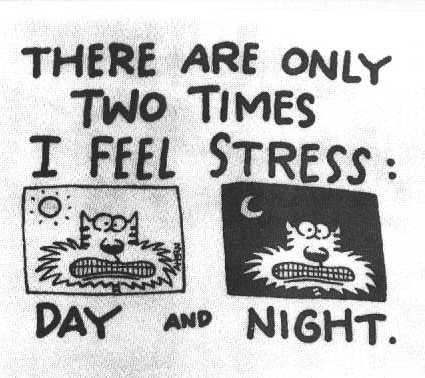
stressI’m depressed, I’m anxious… A better label might be I’m Stressed.

“Chronic stress disrupts nearly every system in your body. It can raise blood pressure, suppress the immune system, increase the risk of heart attack and stroke, contribute to infertility, and speed up the aging process. Long-term stress can even rewire the brain, leaving you more vulnerable to anxiety and depression.”

I am aware that for whatever reason I’m more sensitive to stresses than other people. Rather than thinking of myself as a depressed person or an anxious person, perhaps stress is the cause of the depression and anxiety?

It’s all just labels, but perhaps re-framing my problems as symptoms of stress might help re-think and re-manage the obstacles in my life?

The next step- what stresses me out? How can I reduce these stresses, or make myself more resilient to them? If I figure that one out symptoms of depression and anxiety might not be such an issue.

Therapist Session #2

therapy-signIt seems like Phase One of any therapy is building rapport and trust with a client. Certainly, I’m going to be sceptical of any therapist if I can’t prove they are intelligent and competent. So I’m keeping an open mind, agreed to offload my thoughts, talk about my habits and insecurities and feel I got a decent level of understanding back.

The session ended with her summarizing me as a ‘validation seeker’ due to my explanations of being very orderly*, a perfectionist, trying to present myself well and wanting to be better than everyone else. Probably due to feeling invalidated growing up.. I thought- she’s hit the nail on the head with that one! And due to my temperament and higher sensitivity, I was always going to need more validation than I was getting.

Validation

Trying to impress or seek approval and respect from those around us is a natural human instinct. We’re social creatures who have always lived in groups and tribes and need acceptance to survive. It’s part of who we are.

Is validation bad? When is it bad?
When I think of people who need constant validation, I think of shallow bimbo types- they focus on and show of their exterior facade to gain attention at parties, with their friends, over Facebook or whatever. Shallow values annoy me, and I guess being like that isn’t healthy. I’m not like that…
Or to some extent, maybe I am? Perhaps I’ve just learned how to show off subtly because I don’t want a negative judgement and for people to think I’m a douche? I’m conscious of staying in shape, dressing well, driving a nice car, being clean and tidy, having nice things. I want people to notice, but I won’t make my efforts obvious and be all “hey, look at me!”

Rather than show off to my peers, I probably try to validate myself in private more than anything by comparing to others. I ask myself, Am I doing ok? Am I good enough?

Hmm… Not living up to the standards I set myself- Is that anything to do with the notion of validation?

Either way, I can’t see a positive outcome if I don’t stay in shape, if I’m not tidy, if I don’t try to push myself and reach difficult goals. I guess I’m torn between wanting to let go of the stresses of maintaining high standards, and at the same time retaining the benefits that come from having those standards.

I hope there is a solution to that dilemma. I hope the therapy might help with that, or at least for Phase two I’d like to put something new into practice and directly tackle some of my day to day struggles in a new way.

*[Being Orderly is more a positive trait to increase efficiency in one’s life. I don’t know if I am orderly as a means of seeking validation. I simply take pride in my ordering, categorizing and efficiency]

Status Update: 2013 to 2015

2013 and 2014 were pretty good years for me, and I think that’s why self-development took a back seat…

I completed one of my life goals– producing and writing a digital art tuition book. Huge sense of achievement and self-worth from that.

Having a decent girlfriend for a lot of that time helped a lot. Caused a lot of stress when we’d argue and weren’t getting our needs met, but on the whole I was happier having someone in my corner.

I tried canabis and mushrooms as a possible aid to the anxiety. Not sure if it’s any kind of solution and am still interested in further researching and exploring recreational drug use to help with my mental issues. This isn’t trying to get high and have fun. Instead it’s about controlled, regulated substance intake simply to improve my quality of life, while weighing up the pros and cons.

I was concerned that perhaps my ailments (stress, anxiety etc.) were due to some kind of cortisol imbalance (too much stress hormone). I had a blood test to measure salts and other abnormalities and all the results came back ok which is reassuring, but still can’t quite rule it out. It was frustrating that my doctor wouldn’t just put my mind at rest by specifically testing my cortisol levels.
I’ve learned that men perform best with high testosterone, low cortisol levels- making them assertive, motivated, and not stressy and aggressive.

… And I think I’ve generally come to some new understandings about the world, people, my life, my personality, problems and realities.

I’m undergoing a new development phase at the moment:

After re-reading over some of my old posts I realise how much self-development and certain profound realizations have helped me over the years. I’m an improved, more wise person and have made small noticeable changes for the better.

I’ve started 1-1 Therapy. From my experience over the last 15 years, therapists vary massively in terms of ability at delivering treatment, insight and the right tools to the right patients, and I’m hoping to eventually find someone who can help me progress beyond some of longer term barriers and thinking patterns I’ve held. I’m not expecting miracles- after having seen several therapists and counsellors in the past, I’ve come to the realization that they’re often no more intelligent or insightful than I am and have their own list of flaws and weaknesses.

I’ve started going to self-development/mental health meet ups and considering the big picture again and how I can improve my life. On Monday I met with a fellow Social Anxiety sufferer who seemed to be in a similar place to myself- trying to figure out life, his ailment and how to cope. On Tuesday a ‘Manage your mind’ workshop– essentially group meditation with a yoga breathing exercise. Something I’m partially sceptical about- Can 20 minutes of closing your eyes and breathing differently make a noticeable difference to one’s day? I guess I’ll try not to question it and simply trial it and see what happens.

2015:

I’m having a mix of good days and bad. I feel that underlying depression is always close by even on the good days, but today I’ve been ok. Tomorrow I may not.

Currently I don’t exactly know what I need to work on most or where I’m at. I feel I’ve made some small steps forward in various aspects of my life and some things I already had covered without needing to make any effort. I’m doing more which is great, but anxieties and my general outlook are still an issue. Should I try to:

  • Cultivate a sense of hope and set future goals?
  • Change and improve my daily routine?
  • Improve my physical health and lifestyle. Will physiological changes effect my mental state more than anything else?
  • Re-evaluate my priorities, perhaps work on becoming more giving and helping others to gain fulfilment within myself?
  • Correct my sleeping cycle?
  • Establish a better work ethic?
  • Find a drug/s, or supplement or even people that improve the quality of my life?
  • Learn to accept myself and ailments, and construct the best life I can around my shortcomings rather than struggle to change them?
  • Create new daily life habits by more conscious of things like: laughing more and making jokes, correcting body language, correcting breathing, helping and doing favours for people…

Lots to consider and think about.

Thoughts about positivity and anxiety

mind puzzleI’d taken a lot of time out from my self development. Life got in the way and I got busy.

Today I sat down to watch a TV Documentary about personalities. It explained theories about why some people are more stressed and anxious than others and how anxiety levels can be changed through mindful meditation and conscious positive focus exercises.

It was another sound bit of proof which contributes to the whole “you get what you focus on in life” theory. Look for the positive and you’ll get it, look for the negative and you’ll get it.

I really want to be more positive and less anxious, but perhaps there’s some kinda reasoning going on in my head which makes me continue worrying about the potential negative rather than instead focusing on the possible positive outcomes. Perhaps subconsciously I don’t want to adjust my mindset?
I would guess my brain thinks that anxiety and negative thinking helps: prepare me better for negative outcome, lets me plan for future events better, the added pressure I give myself can motivate me to avoid potential bad scenarios, allows me to see a more balance view of reality, pushes me to keep standards as high as possible.

Perhaps I secretly fear I would lose the above benefits if I were to be a blind, fuzzy-headed optimist?

OR perhaps my sense of self is too wrapped up in the whole anxiety thing? Maybe leaving a part of myself behind would fuck with my ideas of who I am, my sense of self and leave me without a identity I recognize – This could be one of the biggest obstacles in tackling mental health issues or bad thinking habits or habits in general.

I’m conflicted. I keep fluctuating between valuing happiness as the ultimate goal and maintaining a realistic and balanced view of the world. Can a blind optimist be objective and realistic? Happiness on it’s own won’t put food on the table, prepare me for the future and allow me to survive in an uncertain world. Then again, perhaps being a happier person will be the catalyst for life changes that will allow me to gain more than ever before?

Perhaps when I am ready, I can begin mindful meditation and conscious positive focus exercises with the hope that it will lead me to a better existence?

Multitasking

multitasking“If you’ve mastered the art of multitasking, you probably feel you’re getting more done in less time. Think again, experts say. Research suggests you lose time whenever you shift your attention from one task to another. The end result is that doing three projects simultaneously usually takes longer than doing them one after the other.”

Interesting. It makes sense, but equally if I get stuck or lose enthusiasm for one project, it makes sense to take a break by working on something else until I feel ready to go back to the original task.

As a general new rule, I think I’ll try to multi-task less from now on.

Working towards happiness

happiness-road-sign“We need to always be working towards something in order to feel useful and have a sense of purpose.”

I read this quote today on another blog. It’s true and most of us know it. I know it, yet that doesn’t stop me from getting stuck or sometimes I forget what it is I actually want!

Sometimes I check out Maslow’s hierarchy of needs  to remind myself what humans need most and what my priorities should be. It would seem I need to work towards acquiring:

  1. Employment / Money
  2. Love and Sexual intimacy
  3. Self Esteem / Confidence

I never know if I should be chasing the Employment which will result in self esteem through sense of achievement or if I should be chasing Self Esteem so that I am able to function within Employment? I suppose most people get their self esteem without even thinking about it- they do what is expected of themselves: finish school, then go to work, then find a partner, then settle down and so on. Through this process self esteem usually finds them, rather than them needing to find it.

I guess then, employment, a career and money should be my top priorities for now. As mentioned in my previous post, I have been trying with this one. I suppose now that I’ve identified nailing the whole work/ money thing as being most important I should focus most on that.

I will also continue to keep my other goals and activities ticking along in the background. I’ll attempt to carry on with 3 weekly workouts, keeping an eye out for potential girlfriends (I have a date tomorrow in fact), maintaining a small daily blog (separate from this one) and attempt to get some enjoyment from the occasional game, cinema trip, friend meet up, tv show, internet browsing session.

Until I have money or can move out on my own, there’s no point expecting anything new or fun trips out and doing new things every other day.

Making money

hard-workOne part of my life I need to turn around is my career. Or lack of! My worrying question is this:

What do you do when you’re a 30 year old with no in-demand skills, a lack of confidence, little motivation and a resume consisting of just 3 or 4 irrelevant jobs over the last decade with each one mostly lasing no more than a matter of months?

It’s pretty true what they say about the 30 year milestone in one’s life = a time to reflect and assess. I am a fully qualified adult now! Or at least I should be. In reality I’m in the same financial situation I was after just leaving school. How the hell did this happen? 

Being in employment has never been easy for me and I’m sure anyone who has a long history of anxiety, avpd, depression and so on can relate. I STILL don’t know if there is a job out there or some way of working I can do and feel comfortable with. My preferred option has been the idea of working for myself, being a freelancer and entrepreneur. I get to escape the constraints of working to someone else’s rules or working with people I hate BUT then I lack the self motivation and real world knowledge to make a success of things.

So far as going it alone, I have tried:

  • Spending several months creating a personal portfolio and promotional website for myself from the ground up. It’s allowed certain customers to find me, but now only generates a dozen or so hits per day and next to no substantial work. I don’t know how I can substantially promote it. With insufficient knowledge and resources I find myself spending weeks just to get a dozen or so crappy back-links in place.
  • Spending months promoting myself via Facebook, Twitter, Pinterest, Deviant Art, Youtube, Blogger, Squidoo, Forums, Google adwords. I followed the advice I was given by creating decent content on these sites but couldn’t figure out why I would get next to no traffic to these sites, let alone be able to funnel that traffic to my personal portfolio and then convert into real money-earning business opportunities.
  • Entering several art and design competitions. I’d win or place in small $20 prize pool competitions, but it’s hardly worth entering if each takes an average 20 hours of work. For substantial competitions I realize my work is often just not near being good enough to place. There was one exception where I won a $5000 prize.
  • Selling stuff online. Over the course of 5 years on and off I made nearly $18,000 profit selling video games until the competition muscled me out business.
  • Creating two Zazzle Stores. One with 500 products, the other housing over 3000 products. I must have pumped like 500 hundreds of hours into this project, but so far it’s only generated $250 or so!
  • Creating a line of greetings cards and pitching these along with my own design services to over 50 card companies. Unfortunately with no success.
  • Asking over 30 illustration agencies to represent me / find me work. No takers
  • Asking several fine art galleries and art agents to represent me and my work. No takers
  •  Taking art and design commissions via Devintart and Crowdsourcing sites like Freelancer.com. I got several very small jobs, but in the end they’d typically work out at like $2 an hour! Not enough to bother with.
  • Creating custom Tshirt designs for Designbyhumans. My submissions were not ranked high enough to be made, so no luck there.
  • Sent dozens of self promo letters out to potential online stores and businesses, but these generated no work or even replies!
  • Sent several letters to design agencies asking to work with them on a freelance basis, but these generated no work or even replies!
  • Spending 3 months on creating a high quality, professional 10 page mock-up art manual book for a book project and pitched it a Publisher I knew, but with no success.
  • Tattooing! I bought $2500 worth of equipment and tried teaching myself on and off over the course of 2 years. I earned enough to pay off the cost of equipment but could not get the hang of it enough to start charging anywhere near what a professional would. I spent weeks visiting and writing to over 40 tattoo shops in the area in an attempt to get an apprenticeship, but had no luck.
  • Attending several networking meetings to promote myself. I talked to people who couldn’t really find a use for my skills and ended up with no leads from this.
  • I found a semi-regular paying client! I freelanced for a company I was employed with for a short time as a web designer, they only helped to generate me $3000 of income over the course of 3 years.
  • Spending months applying for about 100 employed roles as a designer. A few interviews, but no job. Not sure I would want to work in that capacity anyway?

I give myself credit for making an effort despite my problems and no one else to help me. I had a few prestigious one-off freelance jobs. One with a very high profile client. It only lasted 3 days, but earned nearly $1000 a day! If only I could get that every day! And I worked with another client for 18 months which earned me around $70,000. I’m happy about this, but after 10 years I would have liked to have earned a fair $500,000 total, like many of my peers. The actual real figure is closer to $150,000. I’m now at a stage where I don’t have my own place and not even earning enough to run my car. I don’t know how to earn a decent wage. I’ve mostly worked for myself and relied on luck to get by, but I want more than to just exist while living with my parents. I’d like to be financially free to move out, support myself and a family one day. I’m 30 now and it’s about time I considered how I’m going to do this.

Happiness Article- Remembering to Savour

Happy_DaysThis was emailed to me, so posting it for future reference!…

——————-
There is this puzzle in most Western (and some Eastern) societies
that is really confusing. See if you can figure it out – we’ll use the
United States as an example.

40 years ago…

The average house was 1000 sq feet, now it’s 2422 sq feet
A McDonald’s cheeseburger cost 30 min of wages, now it costs 3 min
There was 1 car for every 2 households, now there are 2 for every 1 household
Life expectancy has since gone up by an average of 8 years
GDP has since tripled or gone up 8.9 trillion dollars
So we live in bigger homes, make more money, and have longer lives.
If that is the case, how can we explain that in the last 40 years:

The divorce rate has doubled
Teen suicide has tripled
Recorded violent crime has quadrupled
And Depression has increased 10x – that’s right ten times.
If things are getting better, why are people getting worse? There isn’t a
one line answer to this paradox, but I’m going to offer a two part theory:
(1) We have been focusing on the wrong things to make us happy; and
(2) When something is wrong (anxiety, panic, depression) we only practice
reducing the negative feelings – we ignore increasing the positive.

Guess what? Happiness doesn’t come from just reducing negative feelings.
In other words, if everything “bad” in your life were wiped away, you would
not automatically be incredibly happy. To live a joyous, fulfilled, and
meaningful life, you need to practice positivity. Yes, happiness takes practice.

One simple practice you can start with is called savoring. If you rush around
all day long from the moment you get up to the moment you hit the pillow, you
are probably not taking time to savor. Slow down and savor the good stuff.
Savoring has been scientifically researched to increase your well-being. Try
the exercise below.

Exercise: According to researcher, Fred Bryant, there are 4 effective
ways to savor:

Basking: Receiving praise and congratulations
Thanksgiving: Experiencing and expressing gratitude
Marveling: Losing yourself in the wonder of the experience
Luxuriating: Engaging in the senses fully

My request of you is that you pick one of these 4 techniques and sit
down to savor right now. Sit down for 5 minutes (if you’re busy,
even 2 minutes will do). Think about one pleasant thing that happened
today (smell, touch, sight, sound, experience) and close your eyes and
enjoy it. Reminisce about what you loved about it.

As humans we are great at doing and moving and pushing through to
the next goal; but we need to also focus on enjoying, savoring, and
just “being”. Remember, happiness takes practice, so make it part of
your day.

Love & Light,

Amelie Chance
Certified Coach of Positive Psychology
——————-

Note: Not to sound cynical and I appreciate the advice but I wonder who certified her? Herself?

Hmm, the art of savouring. It sounds good in theory, but takes effort and a mindset to want to feel good and in the mood to appreciate the good. This is something I’m not naturally comfortable with. I’ll try to savour things more often though if I remember!